
AI for Honey Analysis: Which pollen is found in honey? [23.11.26]
Research team from the “NutriBee” collaborative project develops automated pollen analysis method.
Pure rapeseed honey – or not quite? Single-flower honeys must contain a certain proportion of pollen from the respective plant. This is assessed by pollen analysis, which is time-consuming and requires specialist expertise. As part of a collaborative project funded by the Federal Ministry of Agriculture, Food and Regional Identity (BMLEH), a research team from the Helmholtz Centre for Environmental Research (UFZ) and the German Centre for Integrative Biodiversity Research (iDiv) in Leipzig worked with several partners to develop an automated, AI-based pollen analysis method for honey testing. The researchers suggest that it could be used for pre-screening. This would provide a quick and cost-effective way to determine whether subsequent analysis using the conventional method is worthwhile. Pollen analysis also provides bee-keepers with valuable information about the food available to their colonies. The study has been published in npj Science of Food: doi.org/10.1038/s41538-026-01188-6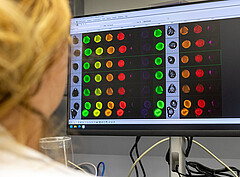
The automated, AI-based method quickly and efficiently identifies pollen. Image source: Stefan Bernhard/iDiv
FUNDED BY THE FEDERAL MINISTRY OF AGRICULTURE, FOOD, AND REGIONAL AFFAIRS
To determine the purity of single-flower honey, accredited laboratories analyse its pollen composition in accordance with the Honey Regulation and the relevant DIN standard. “The pollen contained in the honey is manually identified and counted by specialist staff using a light microscope. This requires a high level of expertise and is time-consuming and expensive. A faster and more cost-effective method would therefore be useful”, says Franziska Walther, lead author and former PhD student at the UFZ and iDiv. Six years ago, the UFZ/iDiv team led by biologist Dr Susanne Dunker developed just such a method as a tool for studying ecological relationships such as plant-pollinator interactions and improving pollen forecasts. In their latest study, the researchers adapted the pollen analysis method specifically for honey testing.
How does the pollen analysis method work?
The automated method combines multi-spectral image-based cytometry with AI, specifically machine learning. The honey samples are prepared in accordance with the standard DIN procedure before the pollen grains are automatically identified and counted one at a time. “The pollen is suspended in a liquid and physically separated into individual grains in a narrow channel. This allows us to capture microscopic images of each pollen grain within a very short time. Lasers are also used to induce fluorescence in certain structures on the surface of the pollen. The location and intensity of this fluorescence vary between pollen types and therefore provide an excellent additional feature for distinguishing and identifying them”, says Dunker. The researchers can measure up to 2,000 particles per second and then identify them using AI.
The reference data consisted of microscopic images produced by researchers from the UFZ and the Julius Kühn Institute in Braunschweig using pollen from six types of single-flower honey (rapeseed, sweet chestnut, sunflower, phacelia, lime and cornflower) as well as pollen collected directly from the corresponding plant species in the field. These images were used to train various AI models before the honey samples were analysed. The models were developed in close collaboration with researchers from Ilmenau University of Technology.
Results: Identify over 1,000 types of pollen in less than 10 minutes
Using their automated method, the researchers analysed 13 single-flower honey samples and 10 mixed honey samples and determined the proportions of the pollen types they contained. They initially analysed only honeys containing pollen from the six plant species included in the reference data used to train the models. To evaluate the results, the research team had the same honey samples analysed using conventional light microscopy at the Lower Saxony State Office for Consumer Protection and Food Safety in Celle. “Our automated method showed 98% agreement with the conventional analysis. We are very pleased with this, particularly given the considerable amount of time our pollen analysis method saves. While a conventional microscopic analysis of a honey sample takes around 30 to 60 minutes, our method allows us to identify well over a thousand pollen grains in less than 10 minutes”, says Walther.
At present, the automated method is intended primarily for pre-screening before conventional pollen analysis in honey testing. This is because the underlying reference database must first be considerably expanded and comprehensively evaluated before the method can be used on a standalone basis. The researchers therefore plan further studies to better understand how the AI models, which currently produce slightly different results, arrive at their classifications. They also plan to expand and improve the underlying image dataset so that the method can be applied more widely in honey testing.
However, Susanne Dunker believes that it could already be used as a pre-screening tool. “This would allow us to determine in advance whether a high proportion of the pollen in a honey sample comes from a particular plant species and whether conventional microscopic analysis would be worthwhile. Rapid and cost-effective pollen analyses would also provide bee-keepers with valuable information about how balanced the food supply around the hive is and whether it supports stable colony development throughout the year”, she says.
BACKGROUND: “NutriBee” Collaborative Project
The research was conducted as part of the project “NutriBee – interaction of abiotic stressors and food limitation on bee health and the development of young colonies under field conditions”, which was funded by the Federal Ministry of Agriculture, Food and Regional Identity (BMLEH). The Federal Office for Agriculture and Food (BLE) served as the project management agency under the Federal Organic Farming Programme. In addition to the UFZ in Leipzig, the project involved the Julius Kühn Institute/TU Braunschweig, the University of Hohenheim, TU Ilmenau/FSU, and the Lower Saxony State Office for Consumer Protection and Food Safety in Celle.
Publikation
Franziska Walther, Martin Hofmann, Martina Janke, Silvio Erler, Elsa Friedrich, Manuel Treder, Demetra Rakosy, W. Stanley Harpole, Patrick Mäder, Alicia Berdún, Thomas Hornick, Susanne Dunker: Profiling of Pollen in Honey using Multispectral Imaging Flow Cytometry. npj Science of Food (2026); https://doi.org/10.1038/s41538-026-01188-6
Text: UFZ / iDiv
Contact for press:
Dr. Susanne Dunker, Helmholtz Centre for Environmental Research (UFZ)-Department of Physiological Diversity, susanne.dunker@ufz.de
Franziska Walther, walther.franziska@outlook.com
