Biodiversity: Hotspots in south-west Germany are losing their species richness [27.10.26]
Joint study by the Stuttgart State Museum of Natural History and the University of Hohenheim: 50 years of Floristic Mapping in Baden-Württemberg reveal significant changes in the flora of Southwest Germany
Stuttgart, October 27, 2026. Climate change and shifts in land use are affecting habitats and, consequently, plant diversity. To better understand the consequences of these developments, long-term and comprehensive data are essential. The “Floristic Mapping of Baden-Württemberg”, coordinated by the Stuttgart State Museum of Natural History, provides a unique foundation for this. The data collected over five decades as part of this citizen science project document significant changes in the flora of southwestern Germany drawing on more than 2.5 million plant observations. They also provide valuable insights into changes in plant diversity in Germany and Central Europe. A research team from the Stuttgart State Museum of Natural History and the University of Hohenheim has now jointly analyzed these data.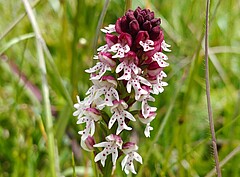
The burnt orchid (Neotinea ustulata, formerly Orchis ustulata) is a rare orchid species found in nutrient-poor, mostly calcareous grasslands. It takes its name from its densely clustered inflorescences, whose still-closed buds are dark red to blackish in colour and thus appear as if burnt. Due to fertilisation and increased land use, suitable habitats – and consequently the populations – in Baden-Württemberg have declined sharply. Credit/Copyright notice: SMNS, Viktoria Ferenc
JOINT PRESS RELEASE
Stuttgart State Museum of Natural History and University of Hohenheim
The results of the joint analysis show that while some areas in southwestern Germany have gained plant species, particularly diverse areas - hotspots of diversity - tend to lose diversity. The analysis underscores how crucial the local context is for biodiversity and effective nature conservation. It is not enough to simply preserve as many species as possible. Conservation measures should be tailored to the specific area and also take into account the ecological characteristics and evolutionary distinctiveness of the plant species found there.
The study was published in the journal Global Change Biology.
More species do not automatically mean greater biodiversity
The plant data revealed a clear pattern: areas that were particularly diverse at the start of the investigations tended to lose diversity over time. Regions such as the Swabian Alb and the Black Forest have been particularly affected, with characteristic species and ecological features in decline. “The question of whether biodiversity is increasing or decreasing overall does not go far enough. Patterns of change vary depending on the area and the aspect of biodiversity under consideration. An increase in species numbers is not automatically positive. If widespread species expand whilst specialised species disappear, landscapes may lose some of their distinctive ecological character. Biodiversity conservation must therefore take regional characteristics into account,” says Dr Viktoria Ferenc, lead author of the study and a researcher at the Stuttgart State Museum of Natural History and the University of Hohenheim.
One of Europe’s longest-running floristic mapping projects
The research team analysed more than 2.5 million plant observations from Baden-Württemberg. These were collected by citizen scientists and professional botanists between 1970 and 2023 for the state’s floristic mapping project, one of the oldest projects of its kind in Europe. The dataset, which has been maintained for over 50 years, comprises just under 2,000 vascular plant species.
Ecological diversity may be at risk despite a stable number of species
In addition to the number of species, the study’s authors analysed the plants’ evolutionary relationships as well as the diversity of their traits, such as height, leaf characteristics and seed size. The various dimensions of biodiversity did not always develop in the same direction. For example, some areas lost distinctive ecological strategies or evolutionary diversity despite a stable number of species. It is therefore crucial to consider not only the number of species, but also which plants are increasing or decreasing over time and what characteristics they possess. “Nitrogen-tolerant and disturbance-adapted species often spread, as do highly competitive or non-native plants. In contrast, habitat specialists – species adapted to wetlands or cool conditions, orchids and species of particular conservation importance – frequently decline. It is therefore crucial to specify exactly what is to be protected,” says Dr Pierre Liancourt, a researcher at the Stuttgart State Museum of Natural History and the study’s senior author.
Local environmental conditions shape development
The extent to which biodiversity changed depended, amongst other things, on the local climate, land use, atmospheric ammonia pollution, soil conditions and topography. “Using the latest statistical methods, we were able to identify patterns in this extensive data that provide important insights into how environmental factors are associated with changes in local plant diversity. However, there was no single factor that could explain all the patterns. Rather, different aspects of biodiversity responded differently depending on local environmental conditions,” says co-author Dr Jörn Pagel from the Department of Landscape Ecology and Vegetation Science at the University of Hohenheim.
The importance of monitoring projects for research and nature conservation
The study highlights the exceptional value of long-term, coordinated citizen science and monitoring projects. “The data from the Baden-Württemberg Floristic Mapping project reveal how our region’s flora is changing and form an important basis for biodiversity research, species conservation, Red List assessments and nature conservation planning. Without the decades-long commitment of volunteer botanists, many of these changes would have remained largely invisible,” says Dr Mike Thiv, co-author of the study and Head of the Botany Department at the Stuttgart State Museum of Natural History. In 2028, the Baden-Württemberg Floristic Mapping project will begin its third survey period. Further citizen scientists interested in supporting the mapping effort are welcome to take part. The Stuttgart Natural History Museum is also currently developing an app designed to simplify the digital recording of plant observations and enable faster access to the data.
Original publication
Viktoria Ferenc, Cornelia Krause, Jörn Pagel, Michael Boxriker, Monika Voggesberger, Arno Wörz, Mike Thiv, Pierre Liancourt: “Five decades of citizen science reveal erosion of hotspots of multifaceted plant diversity”, Global Change Biology, 27 October 2026
DOI: 10.1111/gcb.71150
Publication date: 27 October 2026
URL: http://doi.wiley.com/10.1111/gcb.71150
Funding
With the support of the „Landesanstalt für Umwelt Baden-Württemberg (LUBW)” and the „Ministerium für Wissenschaft, Forschung und Kunst Baden-Württemberg“.
Contact
Dr Viktoria Ferenc, Stuttgart State Museum of Natural History, Department of Botany
University of Hohenheim, Division of Landscape Ecology and Vegetation Science,
+49/(0)711/89 36/203, viktoria.ferenc@smns-bw.de
BACKGROUND: Floristic Mapping of Baden-Württemberg
To document current species turnover and support practical nature conservation measures, the Stuttgart State Museum of Natural History, in collaboration with specialist societies such as the Botanical Working Group of South-West Germany (BAS), the Entomological Societies of Stuttgart and Krefeld, citizen scientists and the Baden-Württemberg State Agency for the Environment (LUBW), is recording species as part of standardised monitoring projects. For more than 50 years, dedicated members of the public have been working alongside the Stuttgart State Museum of Natural History as part of the ‘Floristic Mapping of Baden-Württemberg’ project to record the state’s plant diversity. With around 3.5 million observations, this has resulted in a unique long-term scientific dataset. The data show how the flora of our state is changing – and thus provide an important basis for biodiversity research, species conservation, Red List assessments and nature conservation planning.
Further information and distribution maps are available at:
https://flora.naturkundemuseum-bw.de/start2.htm
Coordination and contact point for Floristic Mapping BW
Dipl.-Biol. Cornelia Krause, Stuttgart State Museum of Natural History, Department of Botany,
+49/(0)711/89 36/204, cornelia.krause@smns-bw.de bzw. floristische.kartierung@smns-bw.de
About the Stuttgart State Museum of Natural History:
The Stuttgart State Museum of Natural History is a forward-thinking research and educational institution. As a biodiversity archive, its research collection comprises over 12 million objects. The museum studies the evolution of life and analyses the biodiversity of various ecosystems, communicating the results of its research to the public.
www.naturkundemuseum-bw.de
Press contact:
Meike Rech, Stuttgart State Museum of Natural History, Communications Department,
+49/(0)711/8936/107, meike.rech@smns-bw.de
About the University of Hohenheim
Founded in 1818 in response to devastating famines, the University of Hohenheim is Stuttgart’s oldest university. Even 200 years later, this highly specialised university remains true to its founding mission: to make innovative contributions to solving global challenges through research and teaching. Today, it is Germany’s number one institution for agricultural research and food sciences, and is also a leading and unique centre for the natural, economic, social and communication sciences. The University of Hohenheim conducts teaching and research on topics including the bioeconomy, sustainability, climate protection, species conservation, food security and alternative sources of energy and raw materials.
www.uni-hohenheim.de
Image material
Please note that the use of the image material is permitted only if the copyright notice is included and solely in the context of reporting on this research. Thank you.
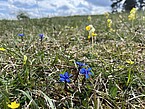
A calcareous nutrient-poor grassland on the Swabian Alb in spring: In the foreground, the bright blue spring gentian (Gentiana verna) is in bloom, alongside the common cowslip (Primula veris). Such sunny, calcareous and nutrient-poor meadows are among the most species-rich habitats in southern Germany. Their diversity is preserved only through extensive use and regular maintenance. Credit/Copyright notice: SMNS, Undine Schöllkopf
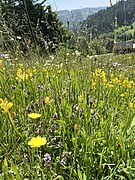
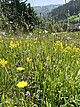
A species-rich, silicate-rich, nutrient-poor meadow in the Black Forest with winged broom (Genista sagittalis). This type of grassland grows on acidic, silicate-rich and nutrient-poor soils and is found on sunny slopes in the Black Forest. It is characterised by low-growing, non-competitive plant species that cannot tolerate intensive fertilisation or frequent mowing. Credit/Copyright notice: SMNS, Undine Schöllkopf
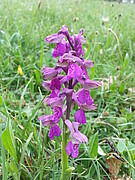
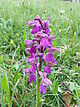
The green-winged orchid (Anacamptis morio, formerly Orchis morio) used to be significantly more common and widespread on nutrient-poor meadows in Baden-Württemberg than it is today. Its populations have declined dramatically in recent decades. This orchid species is classified as endangered in Baden-Württemberg and is listed on the Red List. It grows only on unfertilised, nutrient-poor sites such as semi-dry grasslands. Credit/Copyright notice: SMNS, Mike Thiv
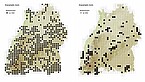
Comparison of the distribution of the green-winged orchid (Anacamptis morio, formerly Orchis morio) in Baden-Württemberg: the map on the left shows records prior to the year 2000, whilst the map on the right shows records since 2000. The comparison highlights the significant decline in the species’ occurrence. Credit/Copyright notice: SMNS, Floristic Mapping of Baden-Württemberg